NEWS | SOFTWARE | SHEET
Types and Reasons of Cracks in Concrete Column

Types of Cracks in Concrete Columns and their Causes
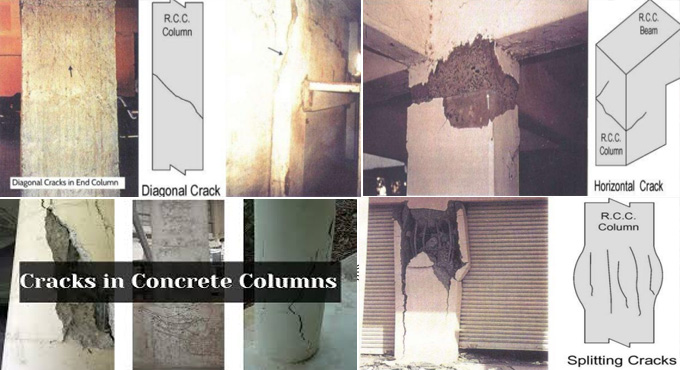
Diagonal Cracks
These types of cracks in the concrete column have developed and encompass the entire face of the column structure anywhere along its height. The reason behind the diagonal cracks is the inadequate load-carrying capacity of the concrete columns. Another cause of diagonal concrete column cracks is insufficient cross-section and inadequate reinforcement of steel. This type of crack can influence the structural soundness of the concrete structure, so it is necessary to deal with this issue properly.
Splitting Cracks
This type of concrete column crack is the short parallel vertical cracks along with the non-uniform width. Those columns are susceptible to the splitting cracks, which are made of low-quality concrete, and there is insufficient steel reinforcement.
These types of concrete column cracks have been initiated due to reaching their maximum load-carrying capacity. The load-bearing capacity of the concrete column has been suppressed, while the concrete cross-sections have been inadequate, or the ratio of reinforcement is insufficient.
Horizontal Cracks
These types of concrete column cracks have been observed to initiate at the junction of the beam-column and on the column face, on which the tensile stress is large. Those columns which have insufficient reinforcements, inadequate moment resistance capacity, or have a disposition of installed reinforcement are prone to these types of cracks in the concrete columns due to the impact of shear forces and direct loads and uniaxial bending. The horizontal cracks can reduce the shear strength of the concrete column, which can lead to an enhanced risk of failure of the concrete structure. This is the reason these types of cracks should be tackled as soon as possible.
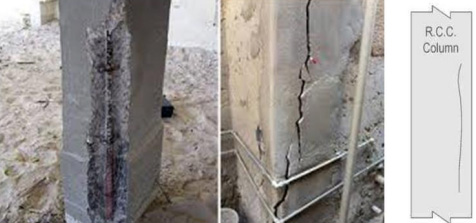
Corrosion Cracks
These types of concrete column cracks have developed along the line of the reinforcements. In addition, these types of concrete column cracks are uniform in width as the concrete column ages. The reason behind corrosion reinforcement in the concrete columns is the inadequate bond between the steel bars and concrete.
Discuss the main causes of cracks in columns
The concrete column cracks have occurred in two forms, which are non-structural cracks and structural cracks. The non-structural cracks in the concrete columns refer to the fine crack that has little or negligible effect on the integrity and strength of the building structure.
This type of crack is less than 2.00 mm in width and appears as a thin hairline crack at any part of the building structure. The non-structural cracks have appeared in the old building structures and have been created as the internal stress forms in the building material. It has occurred because of the varying humidity, different weather conditions and surrounding temperature. The non-structural cracks on the concrete columns can also be caused by creep damage, vegetation or trees, settlement, moving foundations or hydrostatic pressure.
Water will seep through this crack and produce internal pressure, which leads to expanding the cracks in the column structure. On the other hand, the structural cracks in the concrete column affect the strength and stability of the building structure.
These types of cracks are usually wider than 2.00 mm in width and have occurred in the pattern of continuous horizontal cracks on the building walls, vertical cracks, along with relatively wider ones at the top or bottom, diagonal cracks, or stair-step cracks. The incorrect design of the column structure or the deterioration of the building material leads to structural cracks in the concrete columns. Another reason for structural cracks includes settlement of the soils, chemical attack, overloading of the building material or unbalanced pressure of the soil on the concrete column due to the expansion of the soil.
Methods of preventing cracks in concrete columns
Several methods can be followed to prevent cracks in the concrete columns, which are:
Using proper designs and selecting the right materials
The designs of the concrete columns should account for the environmental factors, including the temperature fluctuations and soil movement. The materials used in the concrete columns should also consider the elastic properties, compatible with other building materials and also consider moisture absorption rates.
Using chemical admixtures
Using chemical admixtures in the concrete columns helps to reduce the risks of cracking, as it involves lowering the drying shrinkage of the concrete and helps to improve its overall durability. Incorporating certain synthetic fibres into the concrete mixes also helps to reduce the formation of shrinkage cracks in the concrete column.
Foundation design
A well-designed concrete foundation helps to prevent differential settlement and the resultant cracks in the concrete structure.
Routine maintenance
The progression of the small and non-structural cracks can also be prevented by conducting regular inspections and maintenance of the building structure. This regular inspection leads to the timely repairs of the damaged concrete column cracks and sealing the joints.