NEWS | SOFTWARE | SHEET
Calculating Cement Quantity for Damp Proof Course (DPC)
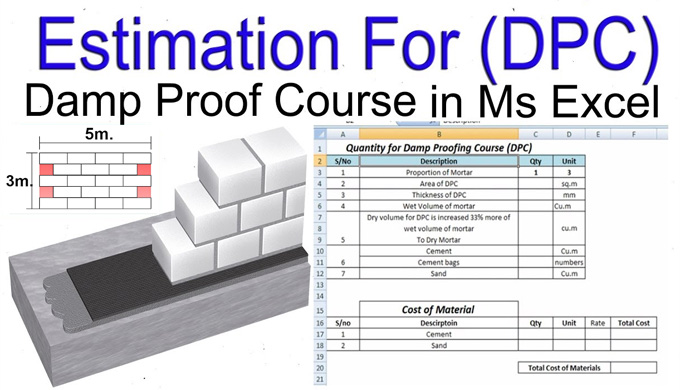
Damp proof course (DPC) refers to the protective layer that has been applied to prevent moisture from rising to the walls from the soil because of the capillary action. The DPC is generally 2.5 cm thick, along with a ratio of rich cement concrete 1:1.5:3 or 2 cm thick with the cement mortar 1:2 that has been mixed with standard waterproofing material. The DPC has been provided from the plinth level to the width of the plinth wall. In this context, the quantities of the materials have been calculated in square meters. In the case of sills of doors and verandah openings, DPC is not provided.
Discuss the quantities of cement and sand in DPC
The DPC has been composed of cement, coarse sand and stone aggregates in a ratio of 1:1.5:3, along with 2% dem-seal, impermo, or acco proof by the weight of the cement or another standard waterproofing compound.
The DPC has been applied in a horizontal layer of 2.5 cm thickness at the plinth level. While preparing DPC, fresh Portland cement has been used as per the traditional standard. While preparing the DPC, the sand that has been used must be clean and coarse. In this case, the particle size of the sand should be 5 mm or less. The stone aggregate in the DPC must be solid and rigid, with a particle size of 20 mm, and it should be well graded and free of filth and dust. In the DPC, other materials have also used, including cico, pudlo and other types of waterproofing compounds, and the quantity of these materials should follow the manufacturer’s instructions.
Learn about the methods of DPC installation in construction work
There are numerous methods that have been used while installing DPC in the building construction process, which are as follows:
Membrane Damp Proofing Method
This is the traditional method of DPC installation, which involves the placement of a damp-proof layer at the plinth level. The materials that have been used in the membrane damp proofing method are:
- Bituminous felt rolls
- Polythene sheets, which are basically 0.25 mm thick.
- PVC/HDPE sheets
These materials have been laid over a levelled base of concrete and can cover the entire width of the plinth wall.
Integral Damp Proofing Method
In this type of DPC installation method, water-repelling admixtures have been added directly into the concrete or mortar during the mixing process. This method helps to reduce permeability and also helps to improve the resistance to moisture ingress. The most common compounds used in this DPC installation method are calcium stearate, metallic soaps, silicates, and several commercial products, such as Dr Fixit Pidiproof or Fosroc Conplast.
Surface Treatment Method
In this type of DPC installation method, the exposed surface has been coated with the moisture-resistant compound, which helps to block the capillary pores.
Pressure Grouting Method
In this method, cement slurry or waterproof grouts have been injected under pressure into cracks or porous areas in the walls or foundations of the construction structure. The pressure grouting method has been used for the damp-proofing of basements, old masonry, or foundations.
Horizontal DPC Installation Method
In this type of DPC installation procedure, a level surface should be prepared above the plinth level. After that, a layer of rich cement mortar should be applied in a 1:3 ratio. After applying the cement mortar layer, the DPC material, such as a bitumen sheet or asphalt layer, should be placed. In the next step, a complete overlap at the joints should be ensured. After that, another mortar layer should be applied to sandwich the DPC.
Vertical DPC Installation Method
This type of DPC installation method has been used in basements, retaining walls and other exposed substructures. In this case, waterproof coatings or fix membrane sheets need to be applied to the vertical surface of the walls. In the next step, the horizontal DPC should be overlapped at the plinth level. After that, protective layers should be applied, for example, lean concrete or geotextile wraps.
Discuss the factors that influence the DPC installation procedure
Several factors need to be considered while installing DPC at the construction work to ensure its longevity and effectiveness, which are as follows:
Site drainage facility
While installing DPC, it should be installed above the highest water table.
Compatibility of the materials
The DPC should have the ability to bond well with the masonry and mortar.
Thermal expansion feature
DPC should provide overlaps or joints in the flexible materials.
Continuity
While installing DPC, it is also necessary to remember that DPC should be continuous at corners and wall junctions.
Protective layers
Shield helps to protect the DPC layer from mechanical damage.