NEWS | SOFTWARE | SHEET
Design of Reinforced Concrete Retaining Wall

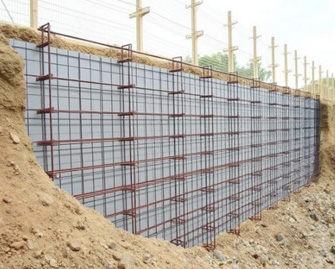
The provision of steel in the concrete is known as the reinforcement process. In this context, steel can be provided in several forms, including wires, bars, fibres, or mesh. The steel reinforcement in the concrete wall acts as a barrier to tensile cracking. In addition, the steel reinforcement in the concrete retaining wall also helps to take up the tensile stresses.
Different types of Reinforcement in the Concrete
The steel reinforcement in the concrete retaining walls can be classified into several types, which are as follows:
Prestressing Steel Reinforcement
In the case of the prestressed concrete members, prestressing steel reinforcement has been used. The prestressing steel reinforcement has been available in the form of strands of steel. In this case, each of the strands of steel consists of steel wires which have been twisted each other around a central wire. After that, the steel strands have been placed in the concrete formwork and prestressed. On the basis of the stage at which the steel strands have been stressed, the resulting concrete member differs; either it will be pre-tensioned or it will be post-tensioned.
In the case of the pre-tensioned concrete members, the steel strands have been stretched to the required level of tensile and concrete has been cast. After hardening the concrete, the prestressing force is released. On the other hand, in the case of the post-tensioned concrete members, the steel strands have been placed in ducts and anchored at the end of the members. After the concrete has been cast by following the tensioning of the steel strands, and after hardening, the priestess force has been released.
Fibre Reinforcement
The fibre reinforcement helps to improve the mechanical performance of the concrete. In the case of the fibre reinforcement, small, discrete and discontinuous fibres have been added into the plastic concrete, which helps to bridge the cracks, thus providing post-cracking ductility to the concrete structure. Different types of fibres can be used in the fibre reinforcement process, including steel fibres, carbon fibres, glass fibres, polymeric fibres and asbestos fibres. In this case, the fibres can be of different shapes, including straight, flat, irregular, crimped, hooked or deformed shapes.
Reinforcing Bars
The mechanical properties of the concrete can be improved with the use of reinforcing bars. Different types of materials have been used to make rebars, which are as follows:
Carbon Steel Bars: These types of steel bars are available in different grades and diameters on the basis of the requirements.
Mild Steel Plain Bars: This type of bar can be hot-rolled or cold-worked and also has a plane surface area.
Mild Steel Deformed Bars: The mild steel deformed bars can be used in all types of reinforced concrete structures and also have deformation in the surface areas.
High-Yield-Strength Deformed Bars: These cold-worked deformed bars help to improve the bond between the concrete and steel.
Thermo-Mechanically Treated (TMT) Bars: TMT bars can be used in earthquake-prone areas due to their higher strength.
Glass Fibre Reinforced Polymer (GFRP) Rebar: GFRP rebars can be cost-effective due to their lower weight. In composite construction works, the GFRP rebars can be used effectively.
Corrosion-Resistant Steel (CRS) Bars: CRS bars can be used in those RCC construction works, which are prone to corrosion due to natural calamities. The corrosion in steel can be prevented by CRS bars, thus increasing the longevity of the construction structure.
Epoxy Coated Rebar: The corrosion in rebars can be prevented by the epoxy coating on the rebars.
Welded Wire Fabric (WWF) Rebar: WWF rebar consists of steel rods or bars made with low-carbon steel. These WWF rebars provide additional strength to the concrete structure.
Importance of Steel Reinforcement in Concrete
- The addition of steel reinforcement to the concrete helps to resist the tensile stresses.
- The steel reinforcement also helps to improve the tensile performance of the concrete wall, thus reaching the full capacity of the concrete wall in compression.
- As steel is a homogenous and isotropic material, it helps to provide a warning sign before the occurrence of failure.
- The mechanical properties of the steel are far better than other materials, which helps to prevent early cracking and helps to make the building structure strong and long-term durable.
Reinforcement detailing of the Retaining Walls
- In the case of the plain concrete wall, the vertical steel should be 0.12% for the HYSD bars and 0.15% should be for the mild steel bars.
- The minimum vertical reinforcement should be about 0.4% for the RC walls.
- In the case of the plain concrete walls, the transverse steel is not needed.
- The spacing between the bars should be 450mm or 3t, and the thickness of the RC walls should be less than 100mm.
- Double grid reinforcement is required in the case that the thickness of the walls is more than 200mm.