NEWS | SOFTWARE | SHEET
How to Calculate Shuttering or Formwork Quantity for Column, Beam and Slab

The shuttering area is also known as the formwork area, refers to the temporary mould that has been used to hold the freshly poured concrete. The shuttering area helps to hold the concrete until it gains sufficient strength to support itself. The shuttering work or formwork acts as the invisible backbone, which helps to shape each and every column.
Beam or slabs before revealing their final form. Generally, the shuttering work or the formwork has been made from centring plywood, timber or steel plates in the traditional Indian construction project. In recent days, modern materials, for example, plastic shuttering sheets and recycled plastic construction materials, have also been used in the shuttering work or formwork. These types of modern materials have longer shelf lives and provide better performance.
Learn about the purpose of shuttering in a construction project
The main purpose of doing the shuttering work or formwork is as follows:
- The shuttering or formwork helps to provide support for the concrete by providing the required shape and alignment to the freshly mixed concrete until it has dried and gained sufficient strength and shape.
- The shuttering work or formwork also helps to achieve the desired finish by ensuring a smooth and uniform surface finish along with fewer defects.
- The shuttering work helps to maintain safety in the construction structure by reducing the risks of collapses and accidents during the curing process.
- The shuttering work helps to allow precise control over the depth of the beams, the thickness of the slabs and the dimensions of the columns.
Discuss the different types of shuttering used in construction work
Timber formwrok
This type of shuttering is affordable and easy to fabricate. Though the timber shuttering is not long-term durable, and can absorb water.
Steel shuttering
The steel formwork is strong enough and can be reusable. Though the steel shuttering is heavy and a little bit expensive.
Plastic shuttering ply and plastic shuttering plywood
This type of shuttering has been made from recycled plastic sheets, which are strong and waterproof. The plasticity shuttering ply can also be reused up to 50 to 100 times if it is handled well.
Shuttering made with recycled plastic boards and recycled plastic construction materials
These types of shuttering have been made with recycled plastic wastes from landfills, which helps to reduce environmental impact while offering excellent performance, thus becoming a growing choice among sustainable builders.
Aluminium shuttering
The aluminium shuttering is lightweight and more precise than the other types of formwork, which have been used for repetitive projects, mostly as mass housing.
Discuss the process involved in the shuttering work
The process of shuttering work involves several steps, which are as follows:
Designing and planning stage
Before initiating the shuttering work, it is necessary to determine the shape, load and the area that is required for shuttering work.
The selection of the materials
The contractor should choose the right type of material to form the formwork. In recent days, plastic shuttering ply has become popular due to its long-term durability and repeat-use potential.
Fabrication stage
In the next step, the materials should be cut and assembled to form the mould structure for concrete. In this context, supports and bracings should be added to withstand the pressure of the concrete.
Applying the releasing agent
In the next step, the releasing agent will be applied to the shuttering area, which helps to remove the shuttering easily without damaging the surface of the concrete.
Concrete pouring and curing process
After pouring the concrete, it needs to be left to harden and achieve the required strength.
Removal of the formwork
After gaining the required strength, the shuttering work should be removed carefully to reveal the final concrete structure.
Understanding the process of calculating the shuttering area or formwork area used in the construction project
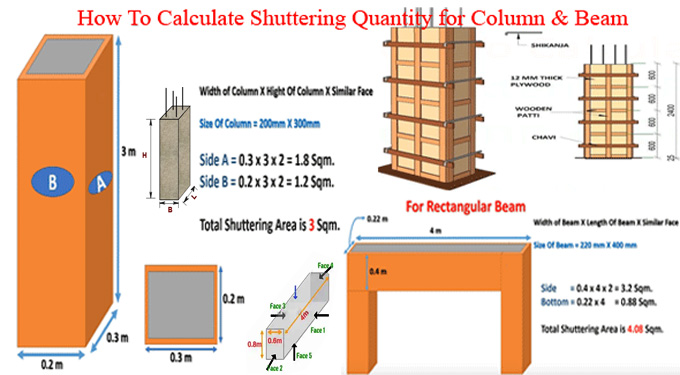
For calculating the shuttering area or the formwork area, several steps need to be followed, which are as follows:
- At first, the contractor should have to identify the surface area of the shuttering. In this context, the area of all surfaces that have been contacted with the concrete, including the side, bottom and edges of the concrete, should have to be calculated.
- After identifying the surface area, the contractor needs to account for repetition. In the case of using centring plywood, the contractor might need more sheets as they can deteriorate faster. While using the plastic shuttering ply, one sheet can be used multiple times.
- In the next step, the wastage amount should also be added while calculating the shuttering area or formwork area. In general, 5 to 10% additional quantity should be considered to accommodate the cuts, wastages and damages.