NEWS | SOFTWARE | SHEET
Tacheometric Surveying: Learn its Principle, Methods, Advantages

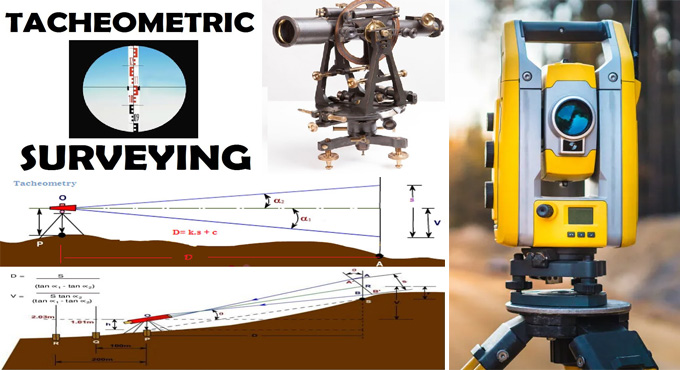
The Tacheometric Surveying refers to the angular surveying process, which helps to employ the optical instruments for measuring the vertical and horizontal distances between two points. The Tacheometric Surveying process helps to eliminate the requirement for traditional chain and tape methods and relies on instrumental observations.
Thus, this surveying procedure helps to determine the distance between the staff station and the instruments. The specialised instruments have been used in the Tacheometric Surveying process to perform the entire survey procedure.
There is no need for tapes, chairs, or any kind of separate levelling instruments. The Tacheometric Surveying process has been employed in various applications, for example, it has been used for the preparation of the topographic maps, reconnaissance surveys for highways and railways or surveying in challenging terrains.
Instruments used in the Tacheometric Surveying procedure
The main instruments used in the Tacheometric surveying method are:
Tacheometer
The Tacheometer is the main instrument of the Tacheometric surveying method, which refers to the transit theodolite along with the stadia diagram. In this context, the stadia consists of two stadia hairs at equal distances, in which one stadia hair has been placed above the horizontal hair of the cross-hairs and another one is placed below the horizontal hair of the cross-hairs.
Stadia Rod
The stadia rod is the ordinary levelling staff used in the Tacheometric surveying method, which has 5 mm graduations that can be used only for measuring short distances. The stadia rod refers to the special type of levelling staff which can be visible clearly from a long distance. The length of the stadia rod used in the Tacheometric surveying method has varied from 3 m to 5 m, and its width ranges between 50 mm to 150 mm. The graduations in the stadia rod are simple and bold, which helps to facilitate the reading even from a large distance. In the Tacheometric surveying method, the stadia rod has been placed normally or vertically to the line of straight.
Discuss different methods of the Tacheometric Surveying process
Different Tacheometric surveying methods have been used, which are as follows:
The stadia system
This is the most widely used method of the Tacheometric surveying method, which can be of different types, which are:
The fixed hair method
In the fixed hair method, the readings are on the staff corresponding to the three wires that have been taken. In this case, the staff intercepted, which means the difference between the readings corresponding to the top of the stadia wire and the bottom of the stadia wire, and it depends upon the distance between the level or stadia staff from the Tacheometer. If the staff intercept is more than its length, then only half the intercept will be read.
Subtense method or movable hair method
In the fixed hair method, a suitable arrangement has been made to vary the distance among the stadia hair as it is used to set them against the two targets on the staff. In the case of intercepting the staff, the two targets have been kept fixed, while the stadia interval, in this regard, the distance between the stadia hair is variable.
The tangential system
In this type of Tacheometric surveying method, reading on the two different points on a staff has been taken against the horizontal cross hair and corresponding vertical angles.
What are the uses of the Tacheometric Surveying process?
- The Tacheometric surveying process has been used for the preparation of the topographic maps, which have been required for both elevations and horizontal distances.
- The Tacheometric surveying process has been performed in difficult terrain, in which the direct methods have been inconvenient.
- The Tacheometric surveying process is also used in the detail filling process.
- The Tacheometric surveying method helps with reconnaissance surveys for railways or highways.
- The Tacheometric surveying process helps to check the distances which have already been measured.
- The Tacheometric survey method has been used for the hydrographic survey processes and helps to establish secondary control.
Discuss the key advantages of the Tacheometric Surveying process
- The Tacheometric Surveying process is one of the fastest surveying processes.
- The Tacheometric Surveying process helps to achieve more accurate results in uneven or difficult terrain, which is quite satisfactory for the surveyors.
- To conduct the Tacheometric Surveying process, any tedious job, along with tapes and chains, is not required.
- The entire Tacheometric Surveying process is cost-efficient in terms of time.
- The Tacheometric Surveying process is useful in those cases where the chain survey or plane table survey can not be carried out.
- The Tacheometric Surveying process can be used to achieve a better check for the chain surveying results, which have been done previously.