NEWS | SOFTWARE | SHEET
Process of Estimating the Size and Capacity of Rectangular Water Tanks
Rectangular water tanks are closed boxes in which water has been stored inside and it has been allowed for regular use. The entry-exit housing of the rectangular water tanks helps to prevent the entry of any dust, waste materials, dirt or harmful materials inside the water tank. The rectangular water tank has a structure which helps to ensure that it has full endurance on the ground, which does not impact the fluctuation of the liquid inside the tank and thus prevents damage to the tank.
The rectangular water tank has a footless and flat bottom, which also helps to ensure the full protection of the liquid inside the tank when it is on the move. The rectangular water tank has been modelled with different storage capacities, including 100 litres, 200 litres, 300 litres, 400 litres or 500 litres.
Discuss the advantages of using rectangular water tanks
Having space efficiency
The rectangular water tank has become popular due to its space efficiency. The rectangular water tanks can be fitted easily into tight spaces, which makes them ideal for urban settings. Teh rectangular water tank can utilise space up to 30% more effectively than circular water tanks. The rectangular water tanks allow strategic placement, which can be positioned against the walls, thus maximising the available space. Therefore, more water can be stored in the tanks without compromising the layout of the property.
Cost effective
As compared to the other shapes of the water tanks, the rectangular water tank is more cost-effective. The design of the rectangular water tanks allows the easy transportation of the water tank, which leads to lowering the shipping costs for businesses. The flat surface of the rectangular water tank is easy to install, and fewer materials are required for construction, which helps to reduce the initial investments.
Easy to install
Most of the design of the rectangular water tanks is straightforward, which allows for quicker assembly of the water tanks. Due to having fewer complicated parts in the rectangular water tank, the installation time has been reduced.
Long-term durable
The rectangular water tank has been made from robust materials, which can resist harsh weather conditions. The rectangular water tank can maintain structural integrity in extreme weather conditions.
Versatility in use
The rectangular water tank is versatile and has been used throughout different industries, including the construction industry, the agricultural industry, and residential usage.
Learn about the process of estimating the size and capacity of rectangular water tanks in litres
According to the IS code, the daily water requirement of a person is about 135 litres. The water requirement has been broken up as per the IS assumptions as follows:
Drinking – 5 litres
Cooking – 5 litres
Bathing & Toilet – 85 litres
Cleaning House – 10 litres
Washing Clothes & Utensils – 30 litres
The size of the rectangular water tank has been decided for a family with 4 members is:
135 litres * 4 = 650 litres/day.
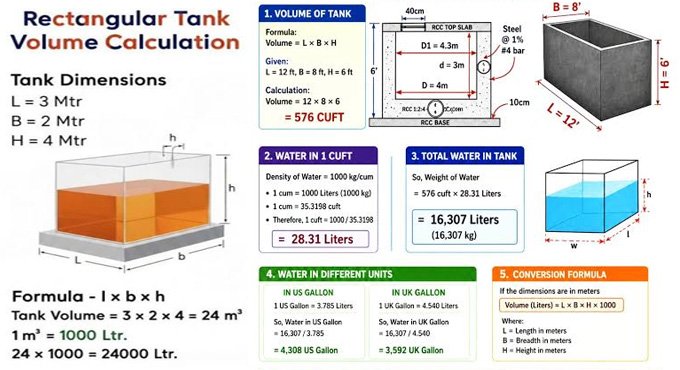
We know that the water volume formula is 1 m3 = 1000 litres of water.
In industrial factories, the steel beam has been used in the production of the building frames and overhead support systems.
To get the rectangular water tank size, the user needs to mention at least one dimension of the water tank.
From above, the water volume formula is 1 m3 = 1000 litres
That means 1 litre = 0.001 m3
In this case, the water requirement is 650 litres
So, 650 litres = 0.65 m3
It has been assumed that the water tank depth is 0.6 m
Area of the water tank = 0.65/0.6 = 1.083 m²
L * B = 1.083 m²
In this case, the length has been taken as 2 times B (L = 2B)
That means the formula will be = 2B * B = 1.083 m²
Therefore, B² = 1.083/2 = 0.54
So, B = √0.54 = 0.74m.
As L = 2B, so 2 * 0.74 = 1.48m.
Therefore, in the case of the 650 litre water tank, L = 1.47 m, B = 0.74 m & D = 0.6 m.
Working process of the rectangular water tank volume calculator
The volume of the rectangular water tank can also be estimated with the help of the calculator. The exact capacity of the rectangular water tank can be estimated by following several steps, which are as follows:
- At first, the length, width and height measurements need to be entered into the calculator. The internal dimensions help to provide the actual storage volume of the water.
- The user has to select the unit per field. In this context, each field has its own selector.
- In the next step, the user has to drag the slider if they want the volume at a partial fill.
- After that, the user has to hit the calculate button, which displays the results instantly. The user can copy or print the result with just one click.