NEWS | SOFTWARE | SHEET
How to calculator used for estimating Bricks, Blocks, and Mortar
The brick mortar is the workable paste that has been used to bind stones, tiles or bricks together. Lime, cement and other ingredients have been used in the brick mortar along with the water and fine aggregate like sand or surkhi. The ratio of these ingredients has been varied on the basis of the ultimate purpose for which the mortar is going to be used.
Discuss the different types of brick mortar used in the construction project
Cement mortar
In this type of brick mortar, the binding material is cement. In this case, the ratio of cement, water and sand varied on the basis of the purpose and durability of the brick mortar.
Lime mortar
In this type of mortar, two varieties of lime can be used, which are hydraulic lime and fat lime. In the case of the dry conditions, fat lime can be used, whereas hydraulic lime is the best option in the heavy rain or water-logging areas.
Gauged mortar
In this type of brick mortar, a combination of lime and cement has been used as the binder, and sand has been used as the fine aggregate.
Gypsum mortar
In this type of brick mortar, the securing material is plaster and soft sand.
Mud mortar
In the case that lime or cement is unavailable, mud can be used as the binding agent in the brick mortar.
Surkhi mortar
To get the surkhi mortar, lime, surkhi and water have been mixed. The surkhi mortar helps to add more strength to the mortar mix.
Epoxy mortar
This type of mortar comprises epoxy resins, solvents, and other materials, which are adhesive and waterproof.
Fire-resistant mortar
In this type of brick mortar, aluminous cement has been used along with the fine powder of the fire bricks and cement, which makes it fireproof.
What are the key components of the brick mortar?
- Cement acts as the binding agent in the brick mortar, which helps to hold everything together.
- Sand helps to prevent cracking in the brick.
- Water is another important component of the brick mortar, which helps to activate the cement and allows the brick mortar to harden.
- Several chemical additives can also be added to the brick mortar, which helps to improve the strength of the brick mortar, water resistance ability or the setting time of the brick mortar.
- The lime is an optional component in the brick mortar, which can improve the flexibility and workability of the brick mortar.
Process of mixing the brick mortar
- While mixing the brick mortar, at first, the ingredients need to be measured, in which 1 part should be cement, and the 2-6 parts should be sand.
- In the next step, the cement and sand should be blended well before adding water.
- After mixing the cement and sand, water needs to be added gradually until a thick and paste-like consistency is achieved.
- The mortar has been set very quickly, so it has to be mixed immediately, within 30 to 60 minutes.
Understanding the brick-laying process
The brick-laying procedure has been done by following several steps, which are:
Spreading the mortar
The builder has to spread a generous layer of mortar along the area where they intend to lay the bricks. Excess mortar should be trimmed off from the side of the spread.
Creating a trench in the mortar
The builder should angle the brick trowel so that the tip will be pointing downward at a 45-degree angle, and can make a trench in the mortar by pressing the trowel.
Laying down the first course of the brick
After creating the trench, one brick has been laid onto one end of the spread, and it has been pushed down evenly until achieving the desired width of the joint. After that, a vertical joint has been created by adding mortar to the end.
Checking the level of the first course and adding the next course of bricks
After laying the first layer of bricks, it should be ensured that the bricks are lined up with each other. The builder can use the line and pins to make a line, which will flush with one of the bricks at either end. After that, the second, third and final courses of bricks have been added by using the same techniques.
Finishing touches
After each layer of the brick is straight, levelled and plumbed, the builder needs to add finishing touches. In this context, a brick trowel, a jointing bar and a soft brush can be used.
Key tools for conducting the brick laying procedure
The basic tools that have been used for laying bricks are:
- Brick Trowel
- Spirit Level
- Jointing Bar
- Lines and Pins
- Tape Measure
- Soft-Bristled Brush
Calculator used for estimating Bricks, Blocks, and Mortar
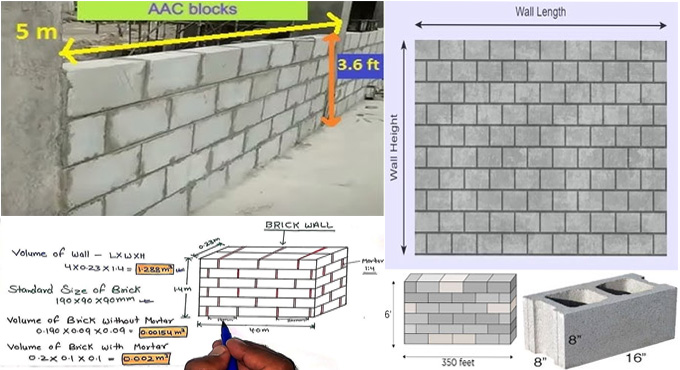
The brick calculator has been used to estimate the number of bricks that are required for the construction work. In the brick calculator, there is a feature which can count the wastage, that indicate the percentage of the bricks which can be destroyed or written off. Thus, the brick calculator provides two numbers: one is the number of bricks required in the construction work, and the other is considered the inevitable wastage.
Process of using the brick calculator
- While using the brick calculator, the builder has to select the type of wall that is going to be built, for example, either a brick wall with a single stack or a double stack.
- In the next step, the builder has to type the length and height of the brick wall or the total area of the brick wall.
- The builders can also add the dimensions of the bricks in the “brick details” section that they wish to use. By putting these above measurements, the builders can get the amount of bricks required for the construction work.
- A wastage percentage of the bricks also needs to be entered to know the number of bricks that need to be ordered. In addition, the builder can also enter the price of the brick that they plan to use to find out the cost of buying all the bricks.