NEWS | SOFTWARE | SHEET
Guide to the Cone Penetration Test (CPT) in Geotechnical Engineering
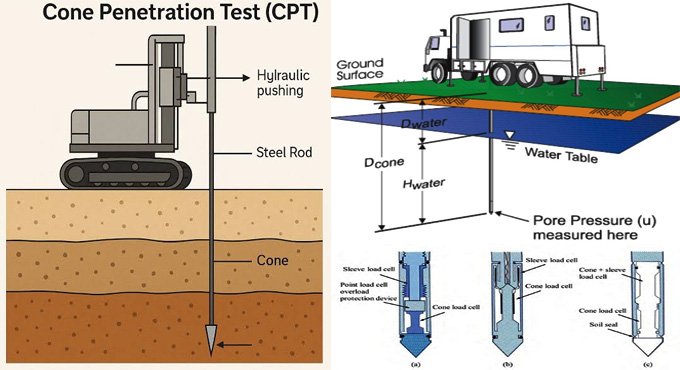
The Cone Penetration Test (CPT) method has been widely used in the geotechnical engineering sector to determine soil properties. Cone Penetration Test (CPT) has been used to estimate the subsurface conditions in the upper 100 ft of the subsurface. There is about 23-ton truck has been used to push the cone into the ground. In this context, the weight of the truck has been supported by the tip of the cone and the sleeve of the cone.
During the Cone Penetration Test (CPT) method, the engineers can measure the tip resistance, which is the stress on the cone’s tip and also measure the sleeve friction, that has been resistance to the surface sleeve. These measurements achieved by the CPT method help to identify the type and stratigraphy of the soil. Most of the CPT devices have been used to record the porewater pressure, which helps to offer additional information regarding the water content of the soil.
Discuss the components of the Cone Penetration Test (CPT)
Cones
The Cone Penetration Test (CPT) method helps to gather information about the soil conditions with the help of the CPT cones. Different types of cones have been used in the Cone Penetration Test (CPT) method, which include:
- Gamma Cone has been used to measure the variations in the gamma radiation.
- Seismic piezocone has been used to combine the standard CPT data along with the geophones, thus can measure the seismic velocity within the soil.
- An intrusive magnetometer system can also be used for conducting the survey of the unexploded bombs throughout a range of environments.
- A video cone penetrometer is also used in the Cone Penetration Test (CPT) method, which helps to record a high-resolution view of the ground in real-time.
- A membrane interface probe has been used in the CPT method to measure the volatile hydrocarbon and solvent contamination with the soil electrical conductance.
- The hydraulic profiling tool has been used in the CPT method to measure the pressure that has been required to inject water flow into the soil.
- Optical Image Profiler tool has been used in the CPT method for the delineation of non-aqueous phase liquid hydrocarbon fuels and oils.
Rigs
This equipment comes in different shapes and sizes on the basis of the project requirements. The rigs have been divided into wheeled and tracked versions. In addition, the engineers can also get the rigs with both wheels and tracks on them, which are known as the track-trucks. Rigs help to allow the supervising engineers and CPT operators to get more comfortable places for work.
Learn about the role of the Cone Penetration Test (CPT) in geotechnical engineering
- The Cone Penetration Test (CPT) method helps to determine the nature and sequence of the subsurface strata.
- The conditions of the groundwater can also be determined with the help of the Cone Penetration Test (CPT) method.
- The physical and mechanical properties of the subsurface strata have also been estimated by conducting the Cone Penetration Test (CPT) method.
Site locations for the Cone Penetration Test (CPT)
- Engineers can push a cone that has been connected to a series of rods into the soil; thus, it can gather continuous information on the resistance of the soil to penetration. This process helps to get invaluable insights into the characteristics of the soil.
- In the case of using wheeled rigs in the CPT method, it helps to get information about hardstanding sites, for example, car parks or roads.
- On the other hand, a tracked crawler rig has been used in soft and boggy sites and can track the testing locations more easily.
- The smaller rigs have been used in the CPT method for the nearshore works into basement or indoor areas where access is restricted.
- The excavator-mounted CPT rigs have been used for rail investigations, including testing the track bed, embankements and cuttings. This type of rig has been also used in the river banks where access is difficult.
Understanding the advantages of the Cone Penetration Test (CPT) in the geotechnical engineering sector
- The Cone Penetration Test (CPT) method is one of the fastest and continuous profiling methods.
- The data obtained by the Cone Penetration Test (CPT) method can be repeatable and reliable for further work.
- The use of the Cone Penetration Test (CPT) method is economical, and it is one of the most productive methods for geotechnical working processes.
- With the help of the Cone Penetration Test (CPT) method, engineers can get a strong theoretical basis for the interpretation of the results.
- With the help of the Cone Penetration Test (CPT) method, engineers can get a significant number of case histories of geotechnical engineering projects.