NEWS | SOFTWARE | SHEET
How to Calculate Paint Quantity and Construction Material Take-off Sheets
Concept of Construction Material Take-off Sheets
The construction material take-off basically provides two types of information, including a comprehensive list of the construction materials that have been required to complete the overall construction work and detailed construction cost estimates for each material that has been required for the construction project. These cost estimates have been combined into total material costs for successfully conducting the overall construction project. The total material costs of the construction project have been adjusted before producing the final material take-off. This feature allows the construction organisation to prepare the material take-off to account for the anticipated fluctuations in the material costs which impact the total construction costs.
Material quantities
The construction material take-off sheet helps to understand exactly which material is required for the construction project. The construction material take-off sheet helps to assign the quantity of the materials on the basis of the construction material types. Four types of material quantities have been seen in the construction material take-off sheets.
The first is the simple count that has been provided for the materials which are prefabricated. In this case, the quantities of hinges, fixtures, doors or windows have been decided. The second one is that the quantities of several materials have been decided by using their length. The quantities of steel piping, lumber, ducting or moulding have been decided depending on the length and width measurements. The third is that the quantities of several materials, like concrete or asphalt, have been measured on the basis of volume. Lastly, several materials’ quantities have been measured by using area.
Material costs
The construction material take-off sheets also help to provide a detailed breakdown of the material costs in the construction project. The construction material take-off requires an individual who prepares the estimate to apply the estimated costs to each type of material needed for the construction project.
Process of preparing material take-off sheets
Going through the project plan
While preparing the material take-off, a review of the project plan should be done by checking the overall construction plans, models and drawings. This process helps determine the types of materials and their total quantities required for the construction project.
Using the construction project plan to list materials
The manual blueprint of the project helps to provide an overview of the materials, though it is risky and prone to errors. On the other hand, the digital construction plans can be fed into the price estimation software, which helps to measure the accurate amount of materials required for the construction project.
Calculating different aspects of the project
The construction material quantities need to be measured accurately to avoid estimates that are too low or too high.
Estimating different quantities for each material
The surveyor needs to estimate the total quantity of the construction materials on the basis of the volume, surface area, and length to conduct the overall construction job successfully.
Getting the final estimate for the project
After determining the material’s quantity, the surveyor also needs to account for price fluctuations, wastage and the supplier quotes. This final step helps to assign a price tag to the construction job.
Concept of the Paint Quantity Take-off Sheets
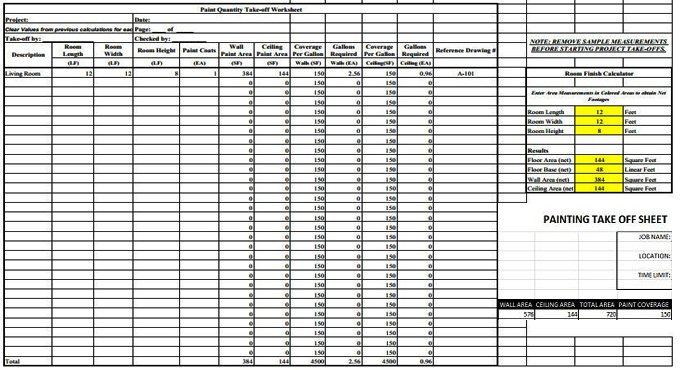
The paint quantity take-off sheets refer to painting and high-performance coatings take-off, which provides how a painted surface has been measured, measures the size at which openings have been deducted, and also measures how the measured area transforms into the coats and paint volume. The paint quantity take-off sheet helps to measure the surface area that needs to be finished and helps to convert the surface into the paint volume, coats and acceptance criteria. The paint quantity take-off sheets also help to cover both architectural painting and high-performance protective coatings on the masonry and steel in the construction project.
Discuss the process of preparing paint quantity take-off sheets
Preparing the page
At first, the estimator needs to create a take-off by uploading the PDF file of the construction plans in the paint quantity take-off software. Then, the estimator needs to set the correct scale before taking measurements.
Setting up the group
The estimator can use an existing group from the Group dropdown in the toolbar and can set up the paint assembly.
Estimate walls
In the next step, the estimator can use the length tool to take the wall measurements on the construction plan.
Adding dimension parameters
After measuring the walls, the estimator needs to add the dimension parameters by clicking the dimension cube.
Ceiling paint
The estimator can use the polygon or rectangle tool to measure the amount of paint required for the ceiling.
Trim paint
The estimator can also use wall and/or ceiling measurements to measure the amount of trim that requires paint, for example, baseboard or moulding.
Add counts
Those components other than walls or ceilings that require paint, for example, doors, also need to be accounted for by the estimator. In this context, the estimator can use the count tool to measure the overall counts of doors and other elements that require paint.
Create estimate
After completing all measurements, the estimators can transfer their take-off measurements into an estimate.