
NEWS | SOFTWARE | SHEET
Complete Understanding of the Spread Footing
Spread footing refers to a shallow foundation type, which has been used to support the walls, columns and structural components by distributing the structural load over a large surface area. The spread footing has been constructed by extending the reinforced concrete base under the construction structure; thus, the spread footing helps to prevent excessive soil pressure on the construction structure.
Discuss the different types of spread footings used in construction work
Key materials used in the construction of the spread footing
The basic materials that have been used in the spread footings are plain concrete or reinforced concrete, brick and stone.
Discuss the construction procedure of the spread footing
Initial stage
At the initial stage of constructing a spread footing, a trench has been dug, formwork has been laid, reinforcement rods have been added, and concrete has been poured into it. After that, the pit is backfilled with the excavated dirt.
Excavation process
In the case of shallow excavation, wall support is usually not required. But, in the case of deep excavation, sloping or wall support is required for maintaining safety.
Supports excavation walls
Supported walls are required for excavation processes which are close to the construction structures or property lines. In the case of deeper excavations, more substantial support systems are required.
Deep excavation process
In the case of deeper excavations than 12 to 15 feet, steel sheet piles or soldier pile systems are required to support vertical cuttings in place of timber sheeting.
Using the special support systems
Steel sheet piles have also been utilised instead of soldier piles in unstable soils, which helps to support the soldier piles in different soil situations.
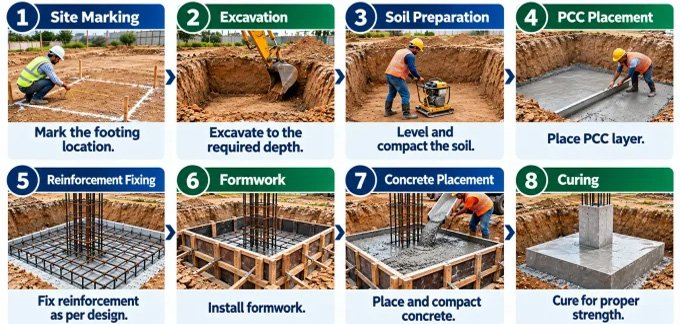
Image Courtesy: jkcement.com
Learn about the advantages of the spread footing
Cost-effectivess
The spread footing requires less excavation and materials as compared to the deep foundations, which helps to reduce the overall costs of the construction process.
Load distribution feature
Spread footing helps to distribute the structural load over a larger area, which helps to minimise the soil pressure, as well as helps to reduce the risks of structural failure of the construction structure.
Easily constructable
The design and construction process of the spread footing is easy and straightforward, which makes it a convenient choice for mid-rise and small building structures.
Requiring minimal maintenance
After constructing the spread footing, it needs little maintenance and also ensures long-term durability.
Appropriate for different structures
The spread footing can be used in different structures, including residential buildings and commercial spaces.
Applications of spread footing in construction projects
- The spread footings are available at a reasonable price and can be used for a range of constructions, for example, residences, factories and commercial buildings.
- The spread footings have been frequently used to support the load-bearing walls in warehouses and multi-storey building structures.
- The spread footings have also been used in bridge constructions and high-rise building structures, as they can distribute the load evenly throughout the structure.
- The spread footing required less excavation and also require less space, which is ideal for the construction structures with intricate designs and construction with small foundation areas.
- In infrastructure projects, marine construction, and oil facilities, with difficult soil conditions, spread footings have been used frequently.
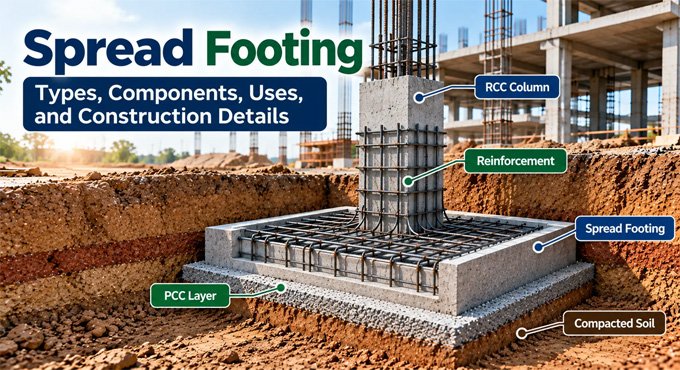
Image Courtesy: jkcement.com