NEWS | SOFTWARE | SHEET
Estimating the Concrete Volume for a Trapezoidal or Sloped Footing
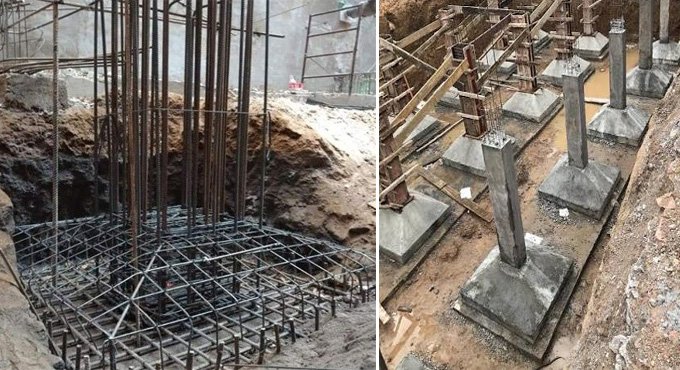
The sloped footing is also termed the trapezoidal footing, which has been designed with inclined sides or slopes. The trapezoidal or sloped footing helps to enhance the contact of the footing’s surface with the soil. The sides of the trapezoidal or sloped footing have been extended from the base of the column to the outer edges of the footing. Thus, this type of footing allows the load distribution of the building structure efficiently and reduces the pressure on the soil.
What are the key components of the sloped footing?
Base
The bottom surface of the trapezoidal footing directly in contact with the ground, which is wider than the top surface.
Slides
The trapezoidal or sloped footing also has sloped or inclined sides, which have been designed to optimise the load-bearing capacity and load distribution of the construction structure.
Top surface
The top surface of the trapezoidal or sloped footing has been connected to the column or wall.
Discuss the materials used in the sloped footing
Concrete
Concrete is the primary material of the sloped footing that has been used to provide strength, durability, and rigidity to resist the structural load.
Concrete blocks
The concrete blocks have also been used in the sloped footing, which are more economical and cheaper than other materials.
Reinforcement
The rebar has also been embedded in the sloped footing, which helps to improve the strength and durability of the footing in those areas with uneven soil conditions.
Importance of trapezoidal or sloped footing in construction
Minimising soil pressure
The sloped footing helps to spread the loads and weight of the building structure evenly over a large area of soil. This load distribution feature helps to reduce the soil pressure and risks of settlement failure. The trapezoidal or sloped footing is appropriate in areas with soft or unstable soil conditions.
Improve load-bearing capacity
The trapezoidal or sloped footing helps to maintain an increased contact area with the ground, which efficiently distributes the load into the foundation structure and helps to provide higher load-bearing capacity.
Improved adaptability
The trapezoidal or sloped footing can adapt to uneven ground conditions, which is beneficial for designing construction projects on uneven sites or sloping ground, without requiring extensive excavation or levelling.
Economical
The trapezoidal or sloped footing can consume a very small amount of concrete, which reduces the costs of material purchases in the construction process.
Design specifications for the trapezoidal or sloped footing
Focusing on the size and shape
While designing the trapezoidal footing, the footing area needs to be evaluated on the basis of the load-bearing capacity. This feature helps to decide the appropriate shape of the trapezoidal footing.
Focusing on the load-bearing capacity
While designing the trapezoidal footing, the load-bearing capacity of the soil also needs to be investigated.
Focusing on reinforcement
This is another important consideration, which is required to resist shear forces and bending moments caused by harsh weather conditions.
Focusing on concrete mix design
While designing the trapezoidal footing, it is also important to specify the compressive strength of the concrete.
Learn about the process of measuring the concrete volume of the trapezoidal or sloped footing
The trapezoidal or sloped footing is the combination of a cuboid and a truncated pyramid. That means, Trapezoidal footing = Cuboid + truncated pyramid. So, the volume of the trapezoidal footing can be calculated by estimating the volume of the cuboid and a truncated pyramid.
In this context,
Volume of Rectangular Cuboid can be estimated by following, length x Breadth x Height = 3 x 2 x 0.3 = 1.8 m³
Whereas, the volume of the Truncated pyramid can be estimated by following,
1/3 (A1 + A2 + √A1A2) x h
Where A1 refers to the Area of the top base, and A2 refers to the Area of the bottom base.
A1 = 0.6 x 0.5 = 0.3 m²
A2 = 3 x 2 = 6 m²
So, the volume of the truncated pyramid = 1/3(0.3 + 6 + √0.3×6) x 0.3 = 0.81 m³
Therefore, the total volume of the trapezoidal footing can be estimated by,
Volume of Cuboid + Volume of Truncated pyramid, that means = 1.8 + 0.81 = 2.61 m³.
So, the total volume of the concrete for a trapezoidal or sloped footing is 2.61 m³.
Discuss the trapezoidal footing volume calculator
This tool has been used in the construction process to find the total volume of the concrete required for the trapezoidal or sloped footing. In the trapezoidal footing volume calculator, the height and breadth of the lower and upper shapes have been entered in the trapezoidal footing volume calculator and has to click on the calculate button to find out the concrete volume of the trapezoidal or sloped footing.